The Fastest Way to Give Positive Feedback in Class

It’s 11:30 am on a rainy Tuesday. You have 28 students in front of you. Three need the toilet, one has lost their glue stick lid, and the noise level is slowly creeping from "productive buzz" to "crowded marketplace."
In moments like these, you know you need to reset the room. You know that positive feedback in the classroom is the most effective tool you have to steer the ship back on course. But who has the time to pull a student aside for a deep-and-meaningful conversation about their work ethic when you are just trying to get through the Maths block?
As Australian teachers, we often feel that "good" feedback has to be long, written, and detailed. But the research—and the reality of our busy timetables—suggests otherwise.
Speed matters. Specificity matters.
In this guide, we are breaking down the absolute fastest ways to deliver high-impact positive reinforcement that actually sticks, helping you build a happier, more focused classroom in seconds.
What Actually Is "Positive Feedback"?
Before we look at the shortcuts, let’s clarify what we are aiming for. Positive feedback isn’t just vague cheerleading ("Good job, mate!").
Effective positive feedback is:
-
Timely: It happens during or immediately after the learning/behaviour.
-
Specific: It tells the student exactly what they did right.
-
Aligned: It connects the action to a goal (learning intention or behaviour expectation).
When you get this mix right, you aren't just being nice; you are reinforcing a neural pathway. You are telling the student's brain: "Do that again."
Why Speed Wins
The educational researcher John Hattie has famously highlighted the power of feedback. However, delayed feedback (like a comment on an essay returned two weeks later) loses its punch.
Immediate feedback closes the gap between the action and the recognition. For a Year 3 student struggling with focus, a visual cue or a quick word in the moment is worth ten times more than a certificate at assembly three weeks later.
The 10-Second Feedback Formula
You don't need five minutes. You need ten seconds. Use this simple three-step formula to turn a generic compliment into a powerful teaching tool.
The Formula:
[Name] + [Specific Action] + [The Impact/Praise]
Example:
-
Name: "Sarah..."
-
Action: "...I noticed you waited until instructions were finished before opening your iPad..."
-
Impact: "...that shows great respect. Thank you."
Total time: 6 seconds.
Why it works: It validates the student personally and explicitly names the behaviour you want the rest of the class to copy.
Fastest Feedback Methods: Ranked
We have ranked these strategies from "Light Speed" (under 2 seconds) to "Super Fast" (under 30 seconds).
1. The Non-Verbal Cue (Speed: Instant)
You don't always need to interrupt the lesson flow with your voice.
-
The Methods: A thumbs up, a specific hand gesture (like the "OK" sign), a wink, or simply making eye contact and nodding while pointing to their work.
-
Best For: Reinforcing on-task behaviour without breaking the silence during independent writing.
2. The "Sticker & Move" (Speed: 5 Seconds)
This is the sweet spot between speed and lasting impact. A verbal comment disappears into the air; a sticker stays on the work (or the jumper) as a visual anchor.
-
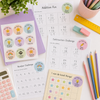
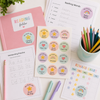
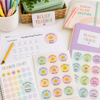
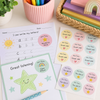
The Method: Keep a sheet of Classroom Reward Stickers on a clipboard or in your pocket. As you circulate, spot the behaviour/learning, stick it, smile, and walk away.
-
Why it works: The physical act of receiving the sticker provides a dopamine hit. Later, when the student looks at their page, the positive feeling is reactivated. This is one of the most efficient ways to use Sticksy Prints Australia products—it’s low friction, high reward.
3. Micro-Verbal Check-Ins (Speed: 10 Seconds)
Short, punchy phrases delivered at the desk.
-
The Method: "I see you’ve used the strategy we practiced. Spot on."
-
Best For: Confirming understanding during Maths or Science.
4. The Whole-Class "Spotlight" (Speed: 15 Seconds)
Highlighting one student to set the standard for the group.
-
The Method: "Stop everyone, eyes this way. Look at how Jack has set out his margins. That is the standard we are aiming for. Thanks, Jack."
-
Best For: Resetting expectations when standards are slipping.
5. Quick Ticks/Codes (Speed: 20 Seconds)
If you are marking live (which you should be!), use codes.
-
The Method: Agree on a code with your class. A double tick might mean "Goal achieved." A star might mean "Creative idea."
-
Best For: Draft feedback where you don't want to write sentences.
15 Ready-to-Use Aussie Feedback Phrases
Stuck for words? "Good work" gets boring. Try these phrases to spice up your positive reinforcement rotation.
For Behaviour & Effort:
-
"That’s the standard, right there."
-
"Legendary effort on that tricky problem."
-
"I love how you stuck with that when it got hard."
-
"You are switched on today!"
-
"Thanks for showing me you’re ready to learn."
-
"That’s a mature choice, well done."
-
"You’re managing your distractions like a pro."
-
"Top quality focus over here."
For Learning & Academic Achievement:
9. "You nailed that strategy."
10. "I can see you used the word wall—smart move."
11. "This sentence? Chef’s kiss."
12. "You’ve cracked the code on this one."
13. "That’s a 'Level 4' answer."
14. "Spot on. Do five more just like that."
15. "I can tell you planned this before you wrote it."
Swap This for That: 5 Examples
Language shapes culture. By tweaking your phrasing slightly, you shift from "judging" the student to "noticing" the behaviour.
| Instead of saying... | Try saying... | Why? |
| "Good boy/girl." | "I appreciate how you helped your peer." | Praise the action, not the person. |
| "Good job." | "You have met the success criteria perfectly." | Connects praise to the learning goal. |
| "You're so smart." | "You worked really hard to solve that." | Praises effort (Growth Mindset) vs fixed ability. |
| "Finally, you're listening!" | "Thanks for switching your focus so quickly." | Keeps it positive rather than sarcastic. |
| "Correct." | "That’s it. How did you work that out?" | Extends the thinking process. |
A Mini-System: The Positive Feedback Rotation
The biggest trap teachers fall into is praising the "loud" kids (either the best behaved or the most disruptive) and missing the quiet achievers in the middle.
Here is a system you can set up tomorrow to ensure quick feedback strategies reach everyone.
The "5-a-Day" Method
The Goal: Give meaningful, specific positive feedback to 5 different students each day. By Friday, you have covered almost the whole class.
The Setup:
-
Print a simple class list grid (Monday to Friday columns).
-
Clip it to your daily planner or whiteboard.
-
Pick 5 students for Monday.
-
During the day, make it your mission to catch them doing something right.
-
Use a [Teacher Reward Sticker Bundle Pack] to seal the deal.
-
Tick them off the grid.
Why this helps:
It forces you to look for the good in students who might otherwise fly under the radar. It ensures your positive reinforcement is equitable and distributed fairly across the room.
Frequently Asked Questions
Is using stickers for older students okay?
Absolutely. While you might swap the "cute animals" for something more typographic or pun-based (like our memes or "vibes" ranges), secondary students crave validation just as much as Year 1s. It’s less about the sticker and more about the recognition that "I saw you, and you did well."
How do I give feedback without stopping the lesson?
Proximity is key. Move around the room while you talk. Drop a sticker on a desk or whisper a "great job" while the rest of the class is working. You don't need the "stage" to give feedback.
Isn't "good job" better than nothing?
Technically, yes. But "good job" is like empty calories. It tastes okay, but it doesn't build muscle. Specific feedback ("Good job on your handwriting") builds the "muscle" of that specific skill.
What if a student rejects praise?
Some students have low self-esteem and feel uncomfortable with public praise. For these students, the "Sticker & Move" method is perfect. It’s private, non-verbal, and allows them to accept the compliment without the social pressure of the spotlight.
How many positives vs negatives should I give?
The "Magic Ratio" often cited in psychology is 5:1. For every one correction or negative comment, try to find five opportunities for positive reinforcement. It sounds like a lot, but using non-verbal cues and Teacher Reward Sticker Bundle Packs counts towards that total!
Internal Link Plan
-
Context: When discussing the "Sticker & Move" method or visual anchors.
-
Anchor Text: Classroom Reward Stickers
-
Link:
[Link to your General Stickers Collection]
-
-
Context: When mentioning the "5-a-Day" system or keeping supplies ready.
-
Anchor Text: Teacher Reward Sticker Bundle Packs
-
Link:
[Link to your Bundles Collection]
-
Image Ideas & SEO Alt Text
Image 1: A close-up of a teacher's hand placing a vibrant sticker on a student's exercise book.
-
Alt Text: Australian teacher placing a positive feedback sticker on a student workbook to reinforce good behaviour.
Image 2: A teacher smiling and giving a "thumbs up" to a student in a classroom setting.
-
Alt Text: Teacher using non-verbal positive reinforcement in a primary classroom to encourage a student.
Image 3: A flat-lay photo of a teacher planner, a pen, and a sheet of Sticksy Prints reward stickers.
-
Alt Text: Sticksy Prints teacher reward stickers and a daily planner used for tracking positive feedback in the classroom.
Ready to speed up your feedback loop?
You don’t need to overhaul your pedagogy to see a change in your classroom vibe. Start with the 10-second formula, grab yourself a set of our Teacher Reward Sticker Bundle Packs, and watch how quickly the atmosphere shifts from "managing" to "thriving."
Happy teaching!