
How to Reduce Teacher Burnout in 2026 | Strategies for Aussie Teachers
Important Note: The following information is for educational and supportive purposes only. It does not constitute medical or psychological advice. If you or a colleague are in crisis, please contact your GP, your Employee Assistance Program (EAP), or call Lifeline on 13 11 14.
It is 2026. The educational landscape in Australia has continued to shift. We are juggling new curriculum iterations, evolving technology, and the lingering social-emotional complexities of the post-pandemic years. If you are reading this and feeling a heavy tightness in your chest on a Sunday night, or a sense of dread when the morning alarm goes off, you are not alone.
Teacher burnout is not a sign of weakness; it is often a sign that you have been strong for too long in a system that demands infinite output from finite resources.
But here is the truth: You are more important than your data wall.
This article isn’t about bubble baths or generic "self-care." It is about structural, practical, and sometimes difficult changes to your daily routine to protect your longevity in the profession. Let’s look at how to reduce teacher burnout in 2026 with strategies that actually work in Australian schools.
Key Takeaways
-
Burnout is systemic but managed personally: While schools need to change, you can control your boundaries immediately.
-
The 3 Levers: Success relies on balancing Workload, Boundaries, and Recovery.
-
Systems save sanity: Automating behaviour management (e.g., using visual tools like stickers) reduces decision fatigue.
-
Recovery is active: Sitting on the couch scrolling TikTok is not recovery; nervous system regulation is.
Identifying Burnout: It’s More Than Just "Tired"
In 2026, the term "burnout" is thrown around loosely, but medically and psychologically, it is distinct from general stress. According to the Maslach Burnout Inventory (the gold standard for measurement), burnout consists of three dimensions.
Do any of these sound familiar?
-
Emotional Exhaustion: You feel drained, unable to cope, and tired even after sleep. You might feel "heavy" physically.
-
Depersonalisation (Cynicism): You find yourself feeling detached from your students. You might think, "I just don't care anymore," or find yourself becoming unusually irritable or snappy with colleagues and children.
-
Reduced Personal Accomplishment: You feel like what you do doesn't matter. Even when a student succeeds, you feel it’s a fluke or "not enough."
If you are nodding your head, it is time to pull the emergency brake—gently.
The 3 Levers: Workload, Boundaries, Recovery
To tackle burnout, we cannot just focus on one area. We need to pull three levers simultaneously.
-
Workload: Reducing the actual volume of tasks.
-
Boundaries: Protecting your time and emotional energy.
-
Recovery: Actively helping your body process stress.
Below are 14 actionable strategies categorised by these levers to help you build a sustainable career.
Actionable Strategies to Reclaim Your Life
Lever 1: Classroom Systems (Reducing Decision Fatigue)
Teachers make upwards of 1,500 decisions a day. This leads to "decision fatigue," a primary driver of exhaustion.
1. Automate Behaviour Feedback
Constantly verbally correcting behaviour or praising students is draining. Use non-verbal visual cues.
-
The Strategy: Use a high-quality sticker system. Walking around and silently placing a "Great Work" or "Spot On" sticker on a student's desk provides the dopamine hit they need without you having to stop your teaching flow or raise your voice.
-
Why it works: It creates a positive feedback loop with zero verbal effort.
-
Tool: Check out our Teacher Reward Sticker Bundle Packs to keep your desk stocked. A simple sticker can prevent the need for a 5-minute behaviour conversation later.
2. Batch Your Lesson Planning
Stop planning day-by-day. It keeps your brain in "emergency mode."
-
The Strategy: Dedicate one afternoon (e.g., Thursday) to plan all of the next week.
-
The 80/20 Rule: 80% of your lessons should be simple, reliable structures. Only 20% need to be "Instagram-worthy" showstoppers.
3. The "Ask Three Before Me" Rule
If 25 students ask you "what do I do next?" in one hour, your brain creates a stress response.
-
The Strategy: strictly enforce a rule where students must ask three peers (or check the board) before approaching you. This isn't lazy; it's fostering independence and saving your sanity.
Lever 2: Marking & Feedback Efficiency
4. Stop Taking Books Home
Make a pact: No marking leaves the school gates. If it doesn't get done at school, the assessment strategy needs to change, not your weekend.
5. Live Marking
Carry a pen and a sheet of Positive Feedback Stickers. Mark the work while the students are doing it.
-
The Benefit: The feedback is instant (most effective) and you finish the lesson with zero piles to collect.
6. Whole-Class Feedback
Instead of writing the same comment 30 times, read the books, note the common errors on one sheet of paper, and teach a 10-minute mini-lesson on those errors the next day.
Lever 3: Admin & Communication Boundaries
7. The Email Curfew
The Department of Education in several states has "Right to Disconnect" policies. Use them.
-
The Strategy: Remove your work email from your personal phone. If that feels too scary, turn off notifications. Set an auto-responder for weekends: "Thank you for your email. I am currently away from my desk and will respond when I return to the classroom on Monday."
8. The "Closed Door" Policy
You do not need to be available to everyone all the time.
-
The Strategy: Two mornings a week, arrive 30 minutes early, close your door, and do not open it for casual chats. Use this time for "Deep Work" (programming or complex marking).
9. Say "No" to the Extras
School concerts, camps, committees, and sports coaching are great—if you have the capacity. If you are burning out, these are the first things to go. See the "Scripts" section below for how to do this politely.
Lever 4: Nervous System & Recovery
10. Complete the Stress Cycle
Stress is a chemical reaction in your body. Even if the stressful situation (the angry parent meeting) is over, the cortisol is still in your blood.
-
The Strategy: You must physically move the stress out. This doesn't mean a gym session. It can be a 20-minute walk, dancing in your kitchen to one song, or a deep crying session. Sleep is not enough; you need movement to signal to your body that "the tiger is gone."
11. Decompression Rituals
Create a boundary between "Teacher You" and "Home You."
-
The Strategy: Change your clothes the second you get home. Have a specific playlist for the drive home that is not school-related (no educational podcasts!).
12. Social Support (Non-Teacher Friends)
Venting to teacher friends is helpful, but sometimes it keeps us in the trauma loop. Ensure you spend time with people who don't know what an ILP or a NAPLAN band is. It reminds you there is a world outside of school.
Lever 5: School-Level Supports
13. Utilise EAP
Every education department and most Catholic/Independent schools offer an Employee Assistance Program. This is free, confidential counselling. You do not need to be in "crisis" to use it. Use it as preventative maintenance.
14. Advocate for Release Time
If you are drowning, speak to your executive team. Ask specifically: "I am struggling to maintain the quality of my teaching due to current administrative loads. Can we look at using some relief budget for a planning day?" The answer might be no, but the answer is definitely no if you don't ask.
A Sustainable Teacher Week: The 2026 Template
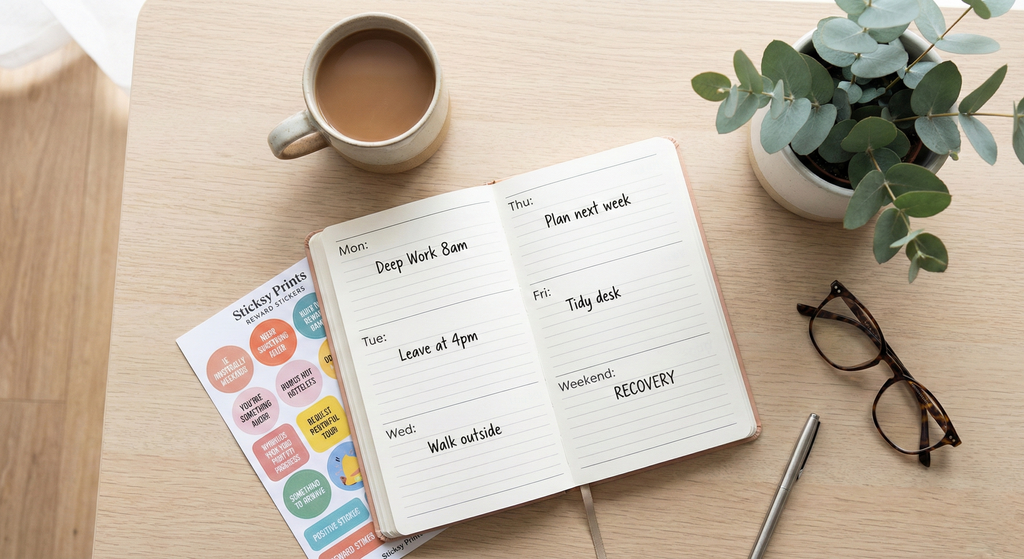
This is what a realistic, sustainable week might look like. Note the lack of work on Saturday and Sunday.
| Time Block | Monday | Tuesday | Wednesday | Thursday | Friday |
| Before School | Arrive 8:00. Deep Work (Closed Door). | Arrive 8:15. Prep materials. | Arrive 8:15. Staff Briefing. | Arrive 8:00. Deep Work (Planning next week). | Arrive 8:15. Casual chat with colleagues (social). |
| Lunch 1 | Duty. | Eat in staffroom (Social). | Student Club / Support. | Eat in staffroom (Social). | Eat in staffroom (Celebrate Friday!). |
| Lunch 2 | Walk outside (Fresh air). | Walk outside. | Duty. | Walk outside. | Walk outside. |
| After School | Staff Meeting (Stay until 4:30). | Marking Hour (Leave by 4:00). | Admin/Emails (Leave by 4:00). | Printing/Prep (Leave by 3:45). | Tidy Desk (Leave by 3:30). |
| Evening | NO WORK. | NO WORK. | NO WORK. | NO WORK. | NO WORK. |
| Weekend | NO WORK. | NO WORK. | NO WORK. | NO WORK. | NO WORK. |
Note: In heavy reporting periods, you may need one 2-hour block on a Sunday morning. Keep it contained.
Small Changes That Compound in 30 Days
If the list above feels overwhelming, start small. Here are three micro-habits that compound over a month:
-
Hydration: Teachers are notoriously dehydrated. Keep a 1L bottle on your desk. Brain fog clears when you are hydrated.
-
One Clear Surface: Before you leave each day, clear one surface (your desk). Walking into a tidy space the next morning lowers cortisol.
-
The Positive Email: Send one positive email to a parent each Friday. It takes 2 minutes. The positive reply you get will fuel you for the next week (and it banks goodwill for when things get tough).
Scripts for Difficult Conversations
Setting boundaries is hard. Here are polite, professional ways to say "No."
Script 1: Declining a Voluntary Committee
"Hi [Name], thanks so much for thinking of me for the Graduation Committee. I’d love to help, but I’m currently at capacity with my teaching load and can't give this the attention it deserves. I’ll have to sit this one out to ensure I’m maintaining standards in my classroom."
Script 2: Responding to an Angry Parent (Holding the Boundary)
"Dear [Parent Name], thank you for bringing this to my attention. I want to give this matter the time it requires, so I will investigate what happened and get back to you within 24 hours. Please note that I do not check emails in the evenings, so I will be in touch tomorrow during school hours."
Frequently Asked Questions
What are the early warning signs of teacher burnout?
Early signs include chronic fatigue, dreading going to work (the "Sunday Scaries"), irritability with students or family, sleep disturbances, and a sense of ineffectiveness or cynicism regarding your job.
Can I recover from burnout without quitting teaching?
Yes, many teachers recover by radically adjusting their boundaries and workload. However, recovery takes time. It involves seeking professional support (GP/Psychologist), taking leave if necessary, and returning with a strict plan for work-life balance.
How do I manage a heavy workload in Australian schools?
Focus on "high-impact, low-effort" strategies. Use whole-class feedback instead of individual marking, automate behaviour management with tools like Sticksy Prints Reward Stickers, and strictly limit the hours you spend at school.
Is it okay to take mental health days?
Absolutely. In Australia, "Personal Leave" (sick leave) covers both physical and mental health. If you are mentally unfit to teach, you are sick. Taking a day to reset can prevent a month-long absence later.
Where can I get help if I am struggling?
-
Lifeline: 13 11 14
-
Beyond Blue: 1300 22 4636
-
Education Support: Contact your union or your employer’s EAP provider.
Image Ideas & SEO Alt Text
Image 1: A calm teacher drinking coffee with a tidy desk.
-
Alt Text: Australian teacher sitting at a tidy desk with a coffee, demonstrating successful workload management and wellbeing.
Image 2: A weekly planner with "Recovery Time" blocked out.
-
Alt Text: Teacher weekly planner template showing blocked out time for deep work and nervous system recovery to prevent burnout.
Image 3: Close up of "Sticksy Prints" stickers being used on work.
-
Alt Text: Teacher using Sticksy Prints positive feedback stickers to quickly mark student work and reduce classroom administration time.
You cannot pour from an empty cup.
Prioritise your wellbeing this year. If you are looking for small ways to bring a spark of joy back into your day and reduce the friction of behaviour management, browse our range of Teacher Reward Sticker Bundle Packs. Sometimes, the smallest systems make the biggest difference.
Take care of yourself.